01Confirmed
The installed base
1,034,738 subscribers (+10%)
Generation is moving from a few very large places to a very large number of small ones. The network already exists at scale — 8,732 MW of it, connected.
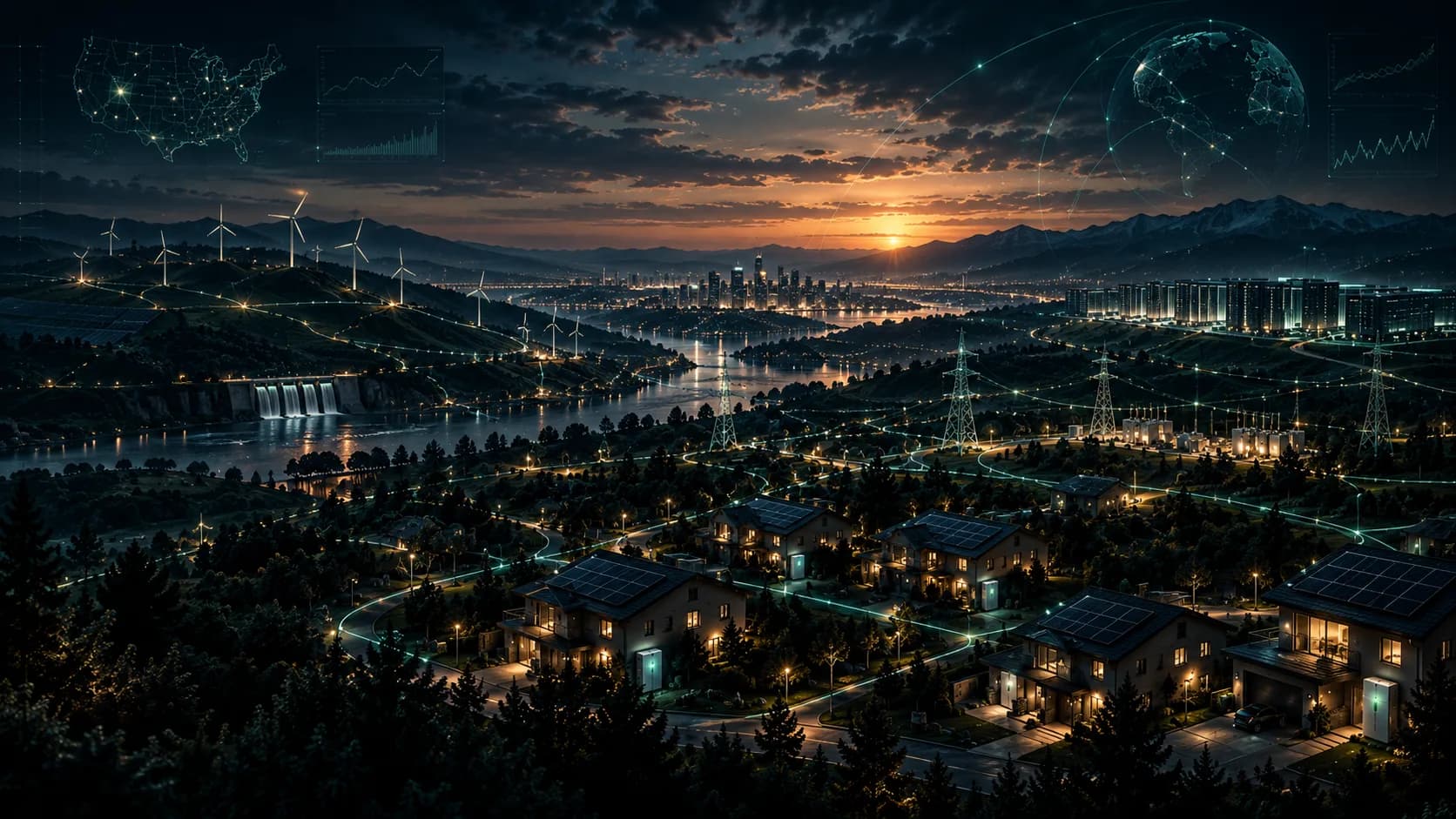
Wall Street sees a residential solar company.
We see a distributed energy network.
Anybody can be bullish for a day.
We're here for the LONG/RUN.
The meme is long.
The thesis is run.
Unfortunately, we kept reading.
Somewhere along the way, the joke became a thesis.
So naturally, we made a memecoin.
The meme is long.
The thesis is run.
The LONG/RUN thesis is that Sunrun may gradually become more valuable as an orchestrator of distributed energy infrastructure than the market gives it credit for as a residential solar company — but proving that thesis requires the battery network, grid-services business and emerging data-centre opportunities to generate meaningful economics while the core business survives policy, financing and execution pressure.
Not “Sunrun is secretly an AI company”. The infrastructure already exists. The open question is how valuable the new monetisation layers become.
1,034,738 subscribers (+10%)
Generation is moving from a few very large places to a very large number of small ones. The network already exists at scale — 8,732 MW of it, connected.
74% attachment · 4.6 GWh
Solar generates when the sun allows it. Storage is what makes that energy controllable, and attachment is at a record.
5+ years median to connect
New transmission is slow. Projects reaching operation in 2025 took a median of more than five years from interconnection request.
6.7–12% of US power by 2028
Compute has to be plugged into something. Data centre load is a new class of buyer arriving in a market that was not built with it in mind.
425 MW · ~18 GWh dispatched
Not a future capability. Eighteen programmes ran in 2025 and dispatched real energy into real grids.
19,793 additions (−31% YoY)
Solar installed fell 23% and storage 15% year over year. This sits here on purpose — it is the strand most capable of breaking the rest.
Electricity demand is changing faster than traditional infrastructure can always be built.
AI data centres require power. Electrification requires power. Grid interconnections take time.
The question
What if millions of distributed batteries and connected homes become part of the infrastructure?
One roof. One meter. Statistically irrelevant.
Generation arrives where the demand already is.
Power becomes storable, and therefore schedulable.
Individually small. Collectively dispatchable.
Capacity coordinated from assets already connected behind the meter.
Compute, electrification, and everything downstream of them.
Your neighbour's battery doesn't look like infrastructure. A million of them do.
18
Programmes
100k+
Participants
~18 GWh
Dispatched
Sunrun's California distributed power plant alone now spans more than 80,000 households and 110,000 batteries, with up to 425 MW of peak dispatchable capacity.
What is demonstrated is the capability. What is not settled is the economics — how much this earns, and for how long. That distinction is the whole thesis, and we are not going to blur it.
Million-home installed base
The network exists at scale. This is the foundation everything else in the thesis is built on.
Storage-first transition
Batteries are what make the fleet controllable, and the mix keeps shifting toward them.
VPP capability
Not a concept. Distributed power plant programmes are operating and dispatching today.
California DPP: 80,000+ homes, 110,000+ batteries, up to 425 MW
AI power-demand macro
The demand backdrop is independently documented. Confirmed as a trend, not as a benefit to any one company.
Data centres ~4.4% of US electricity in 2023; projected 6.7–12% by 2028
Hyperscaler monetisation
An announced Voltus arrangement plus a non-binding three-party framework. Real, early, and not yet material revenue.
Voltus arrangement announced; 16.8 GW framework is non-binding
Distributed AI compute
Compute nodes at homes with Sunrun energy systems. A pilot, carrying no revenue expectation.
Subscriber trajectory
The network must keep compounding for the infrastructure argument to strengthen. Additions are falling.
Q2 additions 19,793 (−31% YoY); solar 174 MW (−23%); storage 332 MWh (−15%)
Cash generation / financial execution
Installed volumes are declining while the model still requires funding ahead of returns.
Installation volumes down across both solar and storage in Q2 2026
Capital costs
The model depends on continuous external financing, and its cost is set entirely outside the company.
Policy environment
Incentive and tariff changes, plus California concentration, are the two things most capable of overwhelming everything above.
Statuses describe the state of the evidence, not a view on any security. “Confirmed” means the underlying fact is reported and cited — it does not mean the thesis is proven. Nothing here is market data, a price signal, or investment advice. This table is reviewed by hand on the dates shown — it is not a live feed.
Stated in advance, so it cannot be quietly revised later. If any of these happen, it gets written up with the same prominence as anything supporting the thesis.
Read it in full
An anonymous research desk with an unreasonable interest in electricity, and a token attached to it for reasons that made sense at the time.
“We read the filings so trench traders don't have to.”
Primary sources, in full, with the boring parts included. The boring parts are usually where the thesis is.
“Good news gets recorded. Bad news gets recorded too.”
Every position we publish carries the conditions that would break it. A thesis you cannot falsify is not a thesis.
“Financial research should not be this entertaining.”
The distribution layer. It is how the reading gets read, and we are not going to pretend otherwise.
An internet-native research project about distributed energy — batteries, distributed power plants, grid constraints and the electricity demand arriving with AI — with a memecoin attached to it. The research is sincere and sourced. The coin is a coin.
The project's token. It is a memecoin. It is not equity, it is not a claim on any company, and it does not entitle you to anything. It does not exist yet — verify the official contract on the verify page before touching anything claiming to be it.
It depends on the context, and we keep the two apart. In research context, RUN refers to Sunrun Inc. and to NASDAQ: RUN, its ordinary listed equity. In LONG/RUN trading context, $RUN refers specifically to the canonical Robinhood Stock Token representing economic exposure to the underlying Sunrun security. The Stock Token is a distinct on-chain instrument — it is not ordinary Sunrun equity. The canonical contract address is published on our verify page.
Both names exist and we keep them apart. In the research, RUN and Sunrun mean Sunrun Inc., the company listed on NASDAQ under the ticker RUN. In a trading context, $RUN means the Robinhood Stock Token. When it matters, we say which one we mean.
Because the pair reads as a sentence. Long RUN. The long run. It is the rare case where the joke and the thesis are the same three words, and we were not going to walk away from that.
That Sunrun may gradually become more valuable as an orchestrator of distributed energy infrastructure than the market credits it for as a residential solar company — provided the battery network, grid services and emerging data-centre opportunities generate real economics while the core business survives policy, financing and execution pressure. Read it in full, with sources, on the thesis page.
No, and this matters. $LONG is a memecoin attached to a research project. Sunrun Inc. is a listed company we have no affiliation with. Buying a memecoin is not investing in a company, and nothing on this site is an offer, a recommendation or financial advice.
The verify page. Every official address and channel is published there and nowhere else. If a link did not come from that page, treat it as hostile.
The thesis page for the long-form argument, the research feed for individual notes, and the terminal for the monitor at a glance. Every quantitative claim carries a numbered source you can open yourself.
The pair
LONG/RUN
Anybody can be bullish for a day. The research keeps going either way.
Research last updated // 07 SEPT 2026